The Deal Flow Illusion: Why Your Network Is Not Your Engine
While your competitors are still waiting for referrals, the fastest-growing private credit funds have built systematic origination machines. Here's the framework they're using—and why it's giving them a 48% conversion advantage.
The Common Struggle
Private credit is booming. The market is projected to reach nearly $2.7 trillion by 2029, with institutional investors pouring capital into alternative lending strategies. Yet despite sitting on massive piles of dry powder, many funds are struggling to deploy capital effectively.
The paradox is brutal: you have the capital, you have the expertise, but you can't scale.
A staggering 75% of deal flow for many emerging funds still comes from the personal networks of the managing partners. This creates a business that is fundamentally fragile. When a key partner has a slow quarter, deal flow dries up. Taking a vacation means the pipeline stalls. Growth isn't dictated by strategy or market opportunity, but by the founder's calendar.
In a market demanding speed and reliability, this manual, artisanal approach is a losing game. The competition isn't just other funds; it's the increasing sophistication of the market itself. Borrowers now expect faster turnarounds, more flexible terms, and proactive outreach—something that ad-hoc, relationship-dependent processes cannot consistently deliver.
The real problem isn't a lack of capital. It's a lack of infrastructure.
The Contrarian Insight: Your Network Is a Source, Not an Engine
The conventional wisdom in private credit is that "it's all about relationships."
This is true. But it's been dangerously misinterpreted as a mandate for manual, one-to-one networking as the sole driver of growth.
The contrarian view, proven by the fastest-growing funds, is this: your network is a source, not an engine.
True scale comes from building an industrialized, multi-channel origination machine that operates independently of any single individual. The goal is to transform deal flow from an art into a science—a predictable, measurable, and optimizable process.
This requires a fundamental mindset shift: from a passive, reactive stance (waiting for referrals) to a proactive, systematic one (building an engine that hunts for opportunities). It means treating borrower acquisition with the same rigor and data-driven approach that is applied to underwriting and portfolio management.
Most funds are caught in what we call The Deal Flow Illusion: the belief that a strong personal network is a substitute for a systematic process. This illusion creates:
Unpredictable pipelines that swing wildly month-to-month
Founder dependency that limits growth to one person's capacity
Fragile businesses that collapse when a key rainmaker leaves
Inability to forecast funded volume with any confidence
Missed opportunities because the team lacks systematic outreach
While your competitors are stuck in this trap, the winners are building something different.
The Framework: The Deal Flow Infrastructure Model
At Morris Enterprises, we implement the M.E. Architecture™ to build systematic origination engines for private credit funds. This isn't about simply hiring more business development reps; it's about building interconnected systems that generate and nurture opportunities at scale.
The framework consists of three core pillars:
Pillar | What It Does | Why It Matters |
|---|---|---|
Systematic Pipeline Management | Full CRM infrastructure with automated workflows, stage-based tracking, and real-time forecasting that predicts funded volume with 85%+ accuracy | Transforms guesswork into data. You can finally answer: "What's closing this month?" in seconds, not days. Strategic planning becomes possible. |
Multi-Channel Borrower Acquisition | Structured broker/ISO programs, direct outreach playbooks, strategic partnerships, and inbound lead generation—creating 5+ systematic deal flow channels | Eliminates referral dependency. Deal flow becomes predictable and scalable, not subject to the whims of your network. |
Operational Leverage | Clear qualification criteria, standardized underwriting workflows, automated follow-up sequences, and team KPIs that allow deals to close without founder involvement | Frees the founder from day-to-day execution. The business can scale beyond one person's capacity. |
This framework is not theoretical. It's the exact system we deployed with a $300M private credit fund entering the U.S. market—and the results speak for themselves.
Proof from the Field: The RTMI Capital Transformation
The Challenge:
RTMI Capital had everything needed to dominate the U.S. private credit market: a proven track record in Israel, $300 million in assets under management ready to deploy, and an experienced team. But eleven months into their U.S. expansion, they were stuck.
Deal flow was unpredictable. They couldn't forecast what would close next month, let alone next quarter. Every deal still required the founder's personal involvement. The team couldn't close without them. Their calendar dictated revenue.
Seventy-five percent of their early deal flow came from personal referrals and warm introductions. There was no systematic borrower acquisition. No multi-channel origination. No way to scale beyond the founder's personal network.
The founder was the bottleneck. Taking a vacation meant deals stalled. Growth was limited by the founder's capacity, not by capital availability. This created an absurd situation: sitting on $300M in deployable capital but unable to put it to work because one person was the constraint.
The Solution:
We embedded with their team for 11 months to build systematic U.S. revenue infrastructure. We didn't consult—we operated as part of the team, building systems, training the team, and iterating based on real-world results.
We deployed the Deal Flow Infrastructure Model with three core transformations:
Systematic Deal Flow Tracking and Pipeline Management
We implemented CRM infrastructure that gave RTMI Capital full pipeline visibility for the first time in the U.S. market. Every deal was tracked by source, stage, probability, and expected close date. Automated reporting replaced manual spreadsheets. The team could see exactly what was closing this month, next month, and 90 days out.
We built source attribution for every deal—referral, direct, partner, broker, marketing. We created stage-based pipeline management with clear conversion metrics at each stage. We implemented automated weekly reporting dashboards showing funded volume by source, conversion rates, and bottlenecks. We developed forecasting models that predicted monthly funded volume with 85%+ accuracy.
Multi-Channel U.S. Borrower Acquisition
We built systematic borrower acquisition channels that didn't depend on the founder's personal network. We created a structured broker and ISO partner program with clear incentives, onboarding, and performance tracking. We developed direct borrower outreach playbooks for the team, targeting specific verticals and deal sizes. We established strategic partnerships with complementary lenders and referral sources. We built inbound lead generation infrastructure through website optimization, content marketing, and SEO.
Operational Leverage and Founder Freedom
We designed operational frameworks that allowed the team to close deals without founder involvement. We created clear deal qualification criteria so the team knew what to pursue and what to pass on. We developed standardized underwriting workflows that reduced cycle time from 60 days to 35 days. We implemented automated follow-up sequences that kept deals moving without manual intervention. We established team KPIs and accountability frameworks—conversion rates, response times, deals closed.
The Impact:
Metric | Before | After | Change |
|---|---|---|---|
Annual Funded Volume (U.S.) | $0 | $150,000,000 | — |
Monthly Revenue (Firm) | $0 | $1,500,000 | — |
Referral Dependency | 75% | 30% | -60% |
Founder Time on Deals | 80% | 20% | -75% |
Time-to-Funding | 60 days | 35 days | -42% |
App-to-Funding Conversion | 22% | 48% | +118% |
Pipeline Forecast Accuracy | <50% | 85%+ | +70% |
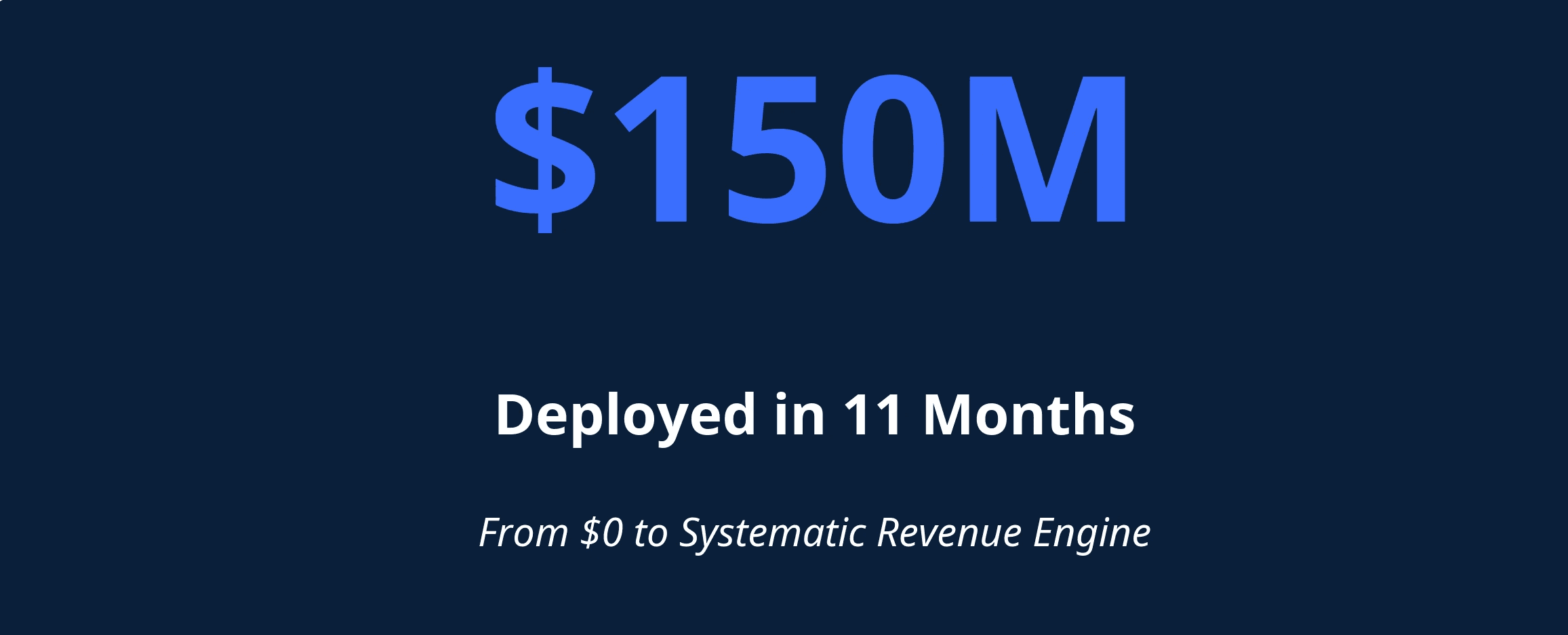
RTMI Capital deployed $150 million in annual funded volume in their first year in the U.S. market, hitting $12.5M in monthly funded volume and $1.5M in monthly revenue for the firm. They went from zero U.S. presence to a scalable revenue engine in 11 months.
The founder went from spending 80% of their time closing deals to 20%, freeing them to focus on strategic partnerships, capital raising, and market expansion. The team operated independently with full accountability and clear KPIs. Deal flow became predictable—they could forecast 90 days out with 85% accuracy.
This wasn't magic. It was the systematic application of the Deal Flow Infrastructure Model.
The Value at Stake
For a fund of RTMI's size, the difference between ad-hoc and systematic origination is the difference between struggling to deploy capital and generating millions in monthly revenue.
The Deal Flow Infrastructure Model delivers three critical outcomes:
De-risks growth: Predictable deal flow means you can plan hiring, allocate capital efficiently, and communicate progress to stakeholders with confidence.
Increases enterprise value: A business that operates independently of the founder is worth significantly more to investors and acquirers.
Creates competitive advantage: In a crowded market, the funds that can evaluate opportunities quickly, underwrite efficiently, and deploy capital at scale will win.
What We're Seeing Across Private Credit
Three observations from our work with private credit funds:
1.Funds with systematic origination are closing deals 40% faster than those relying on referrals. Speed is becoming a competitive weapon in a market where borrowers have options.
2.PIK (Payment-In-Kind) debt is surging—reaching $43.5 billion in Q2 2025—signaling stress in the market. Funds with robust underwriting systems can identify well-managed companies navigating this pressure effectively.
3.The best funds are treating deal flow like a product launch: They're A/B testing outreach messages, tracking conversion rates by channel, and optimizing every stage of the funnel. This is the new standard.
Your Next Move
Ask yourself these three questions:
If your top two rainmakers left tomorrow, would your deal flow survive?
Can you forecast your funded volume 90 days from now with more than 85% accuracy?
Is your team closing deals independently, or are you still the final bottleneck?
If the answer to any of these is "no," you don't have a deal flow engine; you have a collection of personal relationships.
It's time to start building the machine.
About Morris Enterprises
Morris Enterprises is a tactical execution partner for B2B growth. We embed with your team to design, deploy, and optimize the core revenue infrastructure that high-growth companies need to win. We don't just advise; we build the systems, transfer the capabilities, and align our success with yours.
References
[1] Morgan Stanley. (2025). Private Credit Outlook 2025: Growth Potential. Retrieved from https://www.morganstanley.com/im/en-ch/intermediary-investor/insights/articles/private-credit-outlook-2025-opportunity-growth.html
[2] Bloomberg. (2025, November 4). What is Payment-in-Kind Debt? Why Private Credit Funds Are Driving PIK Trend. Retrieved from https://www.bloomberg.com/news/articles/2025-11-04/what-is-payment-in-kind-debt-why-private-credit-funds-are-driving-pik-trend