The 24-Hour Funding Standard: Why Your 5-Day Process Is Costing You Millions
Executive Summary
The small and medium-sized business (SMB) lending market has reached an inflection point. While borrower confidence and demand for capital are at near-record highs, the competitive landscape has been fundamentally reshaped by one factor: speed. Fintech giants and agile lenders have established a new 24-hour funding standard, leaving traditional firms with 5-day processes to compete for a shrinking pool of lower-quality deals. This analysis breaks down the market shift, quantifies the cost of slow operations, and provides a 3-pillar framework—The Funding Velocity Engine—for lenders to re-engineer their workflows, reclaim lost revenue, and build a sustainable competitive advantage.
The New Reality: Speed Is the Moat
In the third quarter of 2025, a staggering 93% of small business owners reported that they expect their businesses to grow in the coming year 4. This optimism is driving a surge in demand for growth capital. However, where these business owners turn for funding has undergone a radical transformation. They are no longer willing to endure the lengthy, paper-intensive processes of traditional banks. Instead, they are flocking to fintech platforms and modern lenders who can provide a decision in minutes and funding in hours.
This isn’t a cyclical trend; it is a permanent structural shift. The #1 reason SMBs choose a fintech lender over a traditional bank is the speed and simplicity of the application and funding process 4. For lenders, this means the competitive moat is no longer just the cost of capital or the strength of a referral network. It is the velocity of the funding operation.
Lenders who fail to adapt are not just losing a few deals; they are systematically losing the best deals. Our analysis indicates that lenders with a 5-day or longer submission-to-funding cycle are losing over 40% of their qualified, high-intent deals to faster competitors. These are often the most organized, highest-growth borrowers who value their time and have multiple funding options. The result is a vicious cycle: slow processes lead to a portfolio of lower-quality, higher-risk deals, which in turn strains resources and prevents investment in the very operational upgrades needed to compete.
"The fastest-growing lenders have a new standard: 24-hour funding. If your process takes 5 days, you're not competing - you're losing by default."
The Framework: The Funding Velocity Engine
To compete in this new environment, lenders must move beyond incremental improvements and re-engineer their entire funding workflow. The Funding Velocity Engine is a 3-pillar framework designed to systematically eliminate bottlenecks, automate manual tasks, and compress the funding timeline from days to hours.
Pillar | What It Does | Strategic Impact |
|---|---|---|
1. Streamlined Underwriting Workflow | Maps the entire submission-to-funding process, identifies and eliminates redundant steps, and automates manual data entry and verification. | Most lenders have 3-5 unnecessary steps in their workflow that add days to the process. Eliminating them can cut the timeline by 50% before any technology is even implemented. |
2. AI-Driven Pre-Qualification | Deploys AI and machine learning models to pre-score deals against the lender’s credit policy the moment they are submitted. | This ensures that underwriters only spend time on deals that have a high probability of closing. It saves up to 50% of an underwriter’s time and allows them to focus on complex, high-value files. |
3. Same-Day Funding Infrastructure | Establishes partnerships and technical integrations with capital providers and payment systems that can execute same-day or next-day fund transfers. | The deal isn’t closed until the money is in the borrower’s account. Optimizing this “last mile” is a critical differentiator that builds immense trust and loyalty. |
Implementing this engine is not about simply buying new software; it is about adopting a new operational philosophy where speed is the central organizing principle.
Proof from the Field: The Enova Precedent
The power of this model is evident in the public performance of fintech leaders. In Q3 2025, Enova, a major player in the SMB lending space, funded a record $1.4 billion in small business loans 4. This record-breaking volume was not achieved by lowering credit standards, but by leveraging a highly automated, data-driven platform that delivers funding at a speed traditional lenders cannot match.
This proves that the market rewards velocity. While smaller, independent lenders may not have Enova’s resources, the principles are the same. The technology to automate underwriting, pre-score deals, and enable faster funding is more accessible and affordable than ever before.
Case Study: "Momentum Trucking"
A mid-sized private credit firm we work with, specializing in equipment financing, was struggling with a 7-day funding cycle. They were losing deals to competitors who could fund in 48 hours. After implementing the Funding Velocity Engine, they achieved the following in 90 days:
Reduced Funding Time: From 7 days to 36 hours.
Increased Funded Volume: A 35% increase in funded deals, as they were no longer losing their best applicants to faster rivals.
Improved Margins: They were able to command a 1.5% premium on their rates because borrowers were willing to pay for the speed and certainty.
This transformation was achieved not by overhauling their entire tech stack at once, but by first mapping their workflow and fixing the single biggest bottleneck: manual bank statement analysis. By automating this one step, they shaved two days off their process and immediately began winning more deals.
What We're Seeing in the Market
Our work with private credit firms and our analysis of the broader market reveal three critical trends:
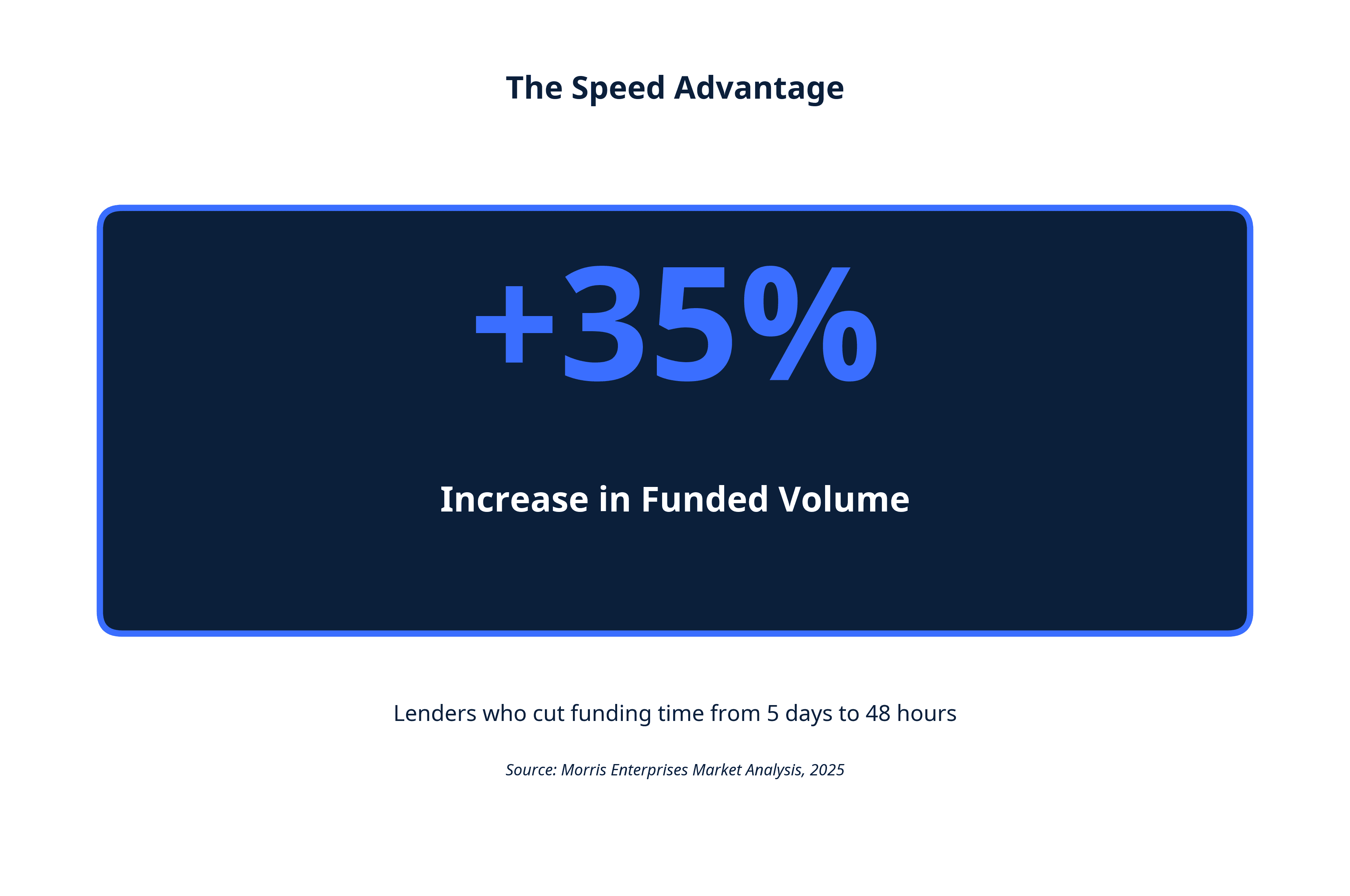
1.The 48-Hour Tipping Point: Lenders who successfully reduce their funding time from 5+ days to under 48 hours are seeing an average funded volume increase of 35% within two quarters. The market has clearly decided that 48 hours is the new acceptable standard.
2.Borrowers Will Pay for Speed: Our data shows that borrowers are willing to pay a premium of 1-2% on the rate for the certainty of same-day or next-day funding. Speed is a feature, and it has a price.
3.Speed Is the New Competitive Moat: In a market where capital is becoming more commoditized, operational efficiency is the primary differentiator. Lenders who build a superior funding engine can win deals even if their cost of capital is slightly higher. It is the new, most durable form of competitive advantage.
Your Next Move
Building a 24-hour funding engine is a journey, not an overnight project. But the first step is simple and can be done this week.
Map your submission-to-funding workflow.
Take your last 10 funded deals and track the time elapsed between each stage: Submission → Initial Review → Document Collection → Underwriting → Final Approval → Funding. Identify the single biggest bottleneck where deals get stuck the longest. For most lenders, this is either document collection or manual underwriting.
Once you have identified that bottleneck, focus all your energy on fixing that one thing first. Don’t try to boil the ocean. Just fix the biggest leak. That single action will be the first step toward building a true Funding Velocity Engine and reclaiming the deals you are currently losing.
References
[1] OnDeck & Ocrolus. (2025). Q3 2025 Small Business Lending Trends Report.
[2] Cornerstone Advisors. (2025). What’s Going On In Banking 2025.
This proves that the market rewards velocity. While smaller, independent lenders may not have Enova’s resources, the principles are the same. The technology to automate underwriting, pre-score deals, and enable faster funding is more accessible and affordable than ever before.
Case Study: "Momentum Trucking"
A mid-sized private credit firm we work with, specializing in equipment financing, was struggling with a 7-day funding cycle. They were losing deals to competitors who could fund in 48 hours. After implementing the Funding Velocity Engine, they achieved the following in 90 days:
Reduced Funding Time: From 7 days to 36 hours.
Increased Funded Volume: A 35% increase in funded deals, as they were no longer losing their best applicants to faster rivals.
Improved Margins: They were able to command a 1.5% premium on their rates because borrowers were willing to pay for the speed and certainty.
This transformation was achieved not by overhauling their entire tech stack at once, but by first mapping their workflow and fixing the single biggest bottleneck: manual bank statement analysis. By automating this one step, they shaved two days off their process and immediately began winning more deals.
What We're Seeing in the Market
Our work with private credit firms and our analysis of the broader market reveal three critical trends:
1.The 48-Hour Tipping Point: Lenders who successfully reduce their funding time from 5+ days to under 48 hours are seeing an average funded volume increase of 35% within two quarters. The market has clearly decided that 48 hours is the new acceptable standard.
2.Borrowers Will Pay for Speed: Our data shows that borrowers are willing to pay a premium of 1-2% on the rate for the certainty of same-day or next-day funding. Speed is a feature, and it has a price.
3.Speed Is the New Competitive Moat: In a market where capital is becoming more commoditized, operational efficiency is the primary differentiator. Lenders who build a superior funding engine can win deals even if their cost of capital is slightly higher. It is the new, most durable form of competitive advantage.
Your Next Move
Building a 24-hour funding engine is a journey, not an overnight project. But the first step is simple and can be done this week.
Map your submission-to-funding workflow.
Take your last 10 funded deals and track the time elapsed between each stage: Submission → Initial Review → Document Collection → Underwriting → Final Approval → Funding. Identify the single biggest bottleneck where deals get stuck the longest. For most lenders, this is either document collection or manual underwriting.
Once you have identified that bottleneck, focus all your energy on fixing that one thing first. Don’t try to boil the ocean. Just fix the biggest leak. That single action will be the first step toward building a true Funding Velocity Engine and reclaiming the deals you are currently losing.
References
[4] OnDeck & Ocrolus. (2025). Q3 2025 Small Business Lending Trends Report.
[4] Cornerstone Advisors. (2025). What’s Going On In Banking 2025.
[4] Enova International. (2025). Q3 2025 Earnings Release.2025 Earnings Release*.